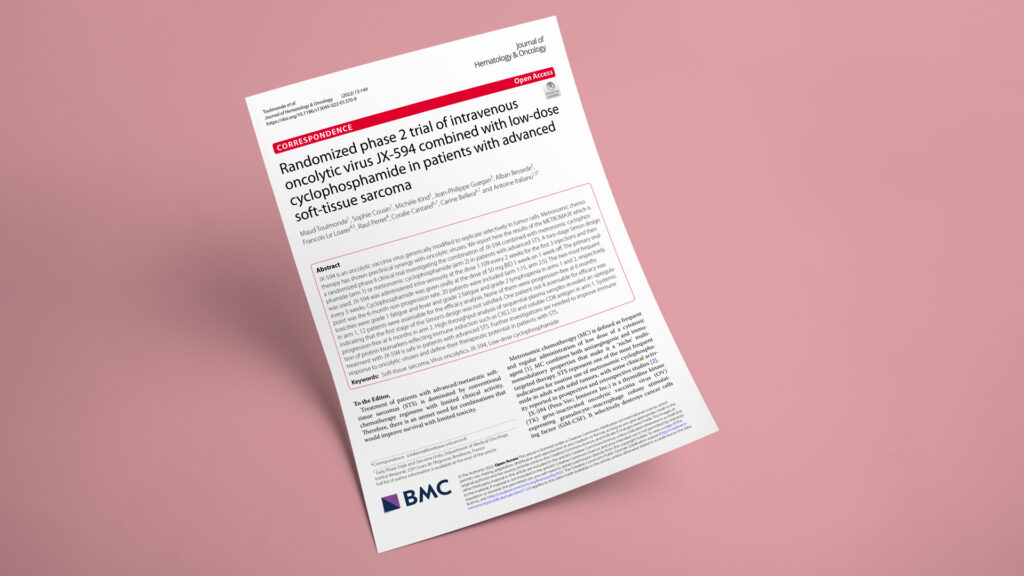
Publication in Journal of Hematology & Oncology

Why systemic oncolytic virus JX-594 stirred an immune signal but not clinical benefit in soft tissue sarcoma

Explicyte collaborated with: Inserm·Institut Bergonié·University of Bordeaux
Randomized phase 2 trial of intravenous oncolytic virus JX-594 combined with low-dose cyclophosphamide in patients with advanced soft-tissue sarcoma
JournalJournal of Hematology & Oncology
DateOct 2022
Read full paper →

Most soft tissue sarcomas are immunologically "cold" — up to 60% are poorly infiltrated and express little PD-L1 — and rarely respond to checkpoint blockade. The randomized phase 2 METROMAJX trial tested whether the intravenous oncolytic vaccinia virus JX-594, paired with metronomic cyclophosphamide, could heat these tumors up. Explicyte's high-throughput plasma proteomics showed the virus induced immune-activation markers such as CXCL10 and soluble CD8A — but also immunosuppressive TGF-β and IL-18. Treatment was safe, yet no patient in the combination arm was progression-free at 6 months.

The randomized phase 2 METROMAJX trial, run by the Early Phase Trials and Sarcoma Units at Institut Bergonié and led by Prof. Antoine Italiano, asked whether systemic delivery of an oncolytic virus could sensitize immunologically “cold” soft tissue sarcoma to treatment. Patients received the intravenous oncolytic vaccinia virus JX-594 (Pexa-Vec) — a thymidine-kinase-inactivated, GM-CSF-expressing poxvirus — combined with metronomic low-dose cyclophosphamide, versus metronomic cyclophosphamide alone. The work was funded by Institut National du Cancer (INCa) and the Association pour la Recherche contre le Cancer (ARC). Explicyte contributed the high-throughput plasma proteomic profiling used to characterize the systemic immune response to virotherapy.

The question

Can a systemically delivered oncolytic virus, paired with metronomic chemotherapy, turn immunologically "cold" soft tissue sarcoma into a tumor that responds to treatment?

Key steps

  1. 1

    Randomized two-arm trial in heavily pretreated sarcoma

    Between April 2017 and February 2018, 20 patients with advanced soft tissue sarcoma were randomized 2:1 to metronomic cyclophosphamide plus intravenous JX-594 (arm 1, n=15) or metronomic cyclophosphamide alone (arm 2, n=5), under a two-stage Simon design. JX-594 was dosed at 1×10⁹ pfu every 2 weeks for the first 3 injections, then every 3 weeks; cyclophosphamide was 50 mg twice daily, one week on and one week off. The population was heavily pretreated, with a median of three prior lines and half having received more than two.

  2. 2

    Combination arm failed the primary endpoint

    Of 12 patients assessable in arm 1, none were progression-free at 6 months, so the first stage of the Simon design was not satisfied. Best response was stable disease in 3 and progressive disease in 9; median PFS was 1.7 months (95% CI 1.1–5.5) and median overall survival 14.2 months (95% CI 4.1–36.4). In arm 2, all 4 assessable patients had stable disease and 1 was progression-free at 6 months, with median PFS of 7.0 months. Systemic JX-594 was well tolerated — grade 1 fever and fatigue predominated and grade 3 events were rare.

  3. 3

    Explicyte profiled the systemic immune response by plasma proteomics

    Explicyte ran high-throughput proteomic profiling (Olink) on sequential plasma samples collected across treatment. Comparing cycle 1 day 22 (after the first JX-594 injection) with cycle 1 day 8 revealed significant upregulation of immune-induction proteins, including soluble CD8A and the T-cell–recruiting chemokine CXCL10 — molecular evidence that the virus engaged an antitumor immune program.

  4. 4

    The immune signal cut both ways

    The same proteomic analysis showed concurrent upregulation of immunosuppressive cytokines TGF-β and IL-18, indicating that JX-594 activates opposing immune programs at once. This double-edged signature — effector recruitment alongside suppression — offers a mechanistic explanation for why measurable immune induction did not convert into durable tumor control in this cohort.

Impact

The trial is a real-world caution for the "cold-to-hot" thesis in sarcoma: a systemic oncolytic virus can be delivered safely and does move immune markers, but the response it triggers is mixed rather than uniformly activating.

0/12
patients progression-free at 6 months in the JX-594 + cyclophosphamide arm (primary endpoint not met)
~60%
of soft tissue sarcomas are immunologically "cold" with low PD-L1 — the rationale for the trial
1.7 mo
median progression-free survival in the combination arm

For developers pursuing oncolytic-virus and cold-to-hot strategies in sarcoma, the safety of systemic JX-594 delivery is a meaningful derisking, but plasma proteomics show why single-agent immune activation may not be enough: the virus simultaneously drives suppressive TGF-β and IL-18 signaling that likely blunts benefit. This argues for pairing oncolytic viruses with agents that counter those suppressive axes, and for serial plasma proteomics as a pharmacodynamic readout in early-phase virotherapy trials. A trial combining intra-tumoral JX-594 with the PD-L1 antagonist avelumab in sarcoma is already underway.

Running an oncolytic-virus or cold-to-hot trial and need plasma proteomic pharmacodynamic readouts of the immune response? Let's talk

Talk to us
Explicyte Oncology CRO logo

Capabilities

Modalities