Custom-fit FFPE transcriptomics for oncology target identification

Whole-transcriptome, single-cell, focused panel, or spatial — we run the FFPE transcriptomic strategy that matches your tumor biology, indication, and decision points.

Explicyte is equipped across the major FFPE-compatible transcriptomic platforms, helping you source the right oncology cohorts and turn the dataset into ranked, defensible target candidates.

Recent transcriptomic papers

Molecular Cancer Research journal logoCancer Cell journal logoClinical cancer research journal logoScience Advances logoCell Reports Medicine journal logoCancer Research CommunicationsClinical cancer research journal logoNature medicine journal logoJournal for ImmunoTherapy of Cancer (JITC)iScience

Our target identification workflow

From samples to ranked targets, in three steps

FFPE cohort & QC

Cohort design that drives target signal

The cohort you build determines the targets you find. We design stratified FFPE cohorts — responder vs. non-responder, treatment-naive vs. treated, indication subtypes — with platform-ready QC, RNAscope, and pathology review built in.

Key outputs

  • Stratification framework aligned with your target nomination logic
  • Inclusion/exclusion criteria with clinical metadata mapping
  • Pathology review and platform-ready FFPE prep (RNAscope-based RNA QC)
About FFPE sourcing

Transcriptomic data generation

The right platform & panel for the question

We help you choose between whole-transcriptome, focused panel, single-cell, and spatial approaches — balancing gene coverage, spatial resolution, throughput, and budget — then execute the strategy across our 10x-certified and bulk transcriptomic platforms.

Key outputs

  • Recommended platform, panel, and multiplexing strategy
  • Raw and processed gene expression matrices
  • QC report with sequencing and dataset metrics
Explore our transcriptomic platforms

Dataset analysis

Target nomination and ranking

Our in-house data scientists turn high-dimensional transcriptomic data into defensible target candidates — ranked on prevalence, expression specificity, druggability signals, and safety markers, with the evidence trail behind each call.

Key outputs

  • Cleaned, normalized, and annotated dataset
  • Integration with clinical metadata and relevant public datasets
  • Ranked targets with evidence trail (prevalence, specificity, druggability, safety)
More about data science services
Discuss your target discovery project

10x genomics-certified service provider for FFPE transcriptomics

Certified across Xenium, Visium HD, and Chromium X

We are platform agnostic. We recommend the FFPE transcriptomic strategy that best fits your biological question.

Explore our 10x Genomics platforms
TechnologyUse case for target IDTrade-offBest fit when
Chromium X Single-cell transcriptomic profiling across large numbers of samples Limited spatial context Transcriptome-wide discovery, cohort screening, and target ranking at scale
Visium HD Spatial transcriptomics with broad discovery power across tissue ~2µm bins approximate single-cell resolution but don't deliver true single-cell precision You need tissue architecture and broad exploratory power in the same experiment
Xenium High-plex spatial profiling at single-cell resolution Panel-based (up to 5,000 genes) rather than unbiased whole-transcriptome Spatial localization, cell-type specificity, and microenvironment context are central
GeoMx DSP Region-of-interest spatial profiling in selected tissue compartments Less cellular resolution than single-cell spatial methods The question is compartment-level (tumor vs. stroma) or pathology-defined regions
Bulk RNA-seq Highest-throughput unbiased transcriptomic profiling at the lowest cost per sample No spatial or cellular resolution — population-averaged signal only You need broad signal across many samples and single-cell/spatial detail isn't required for nomination

Strategies to optimize FFPE-based target identification studies

Rationalizing target discovery: case studies
Leveraging extreme phenotypes

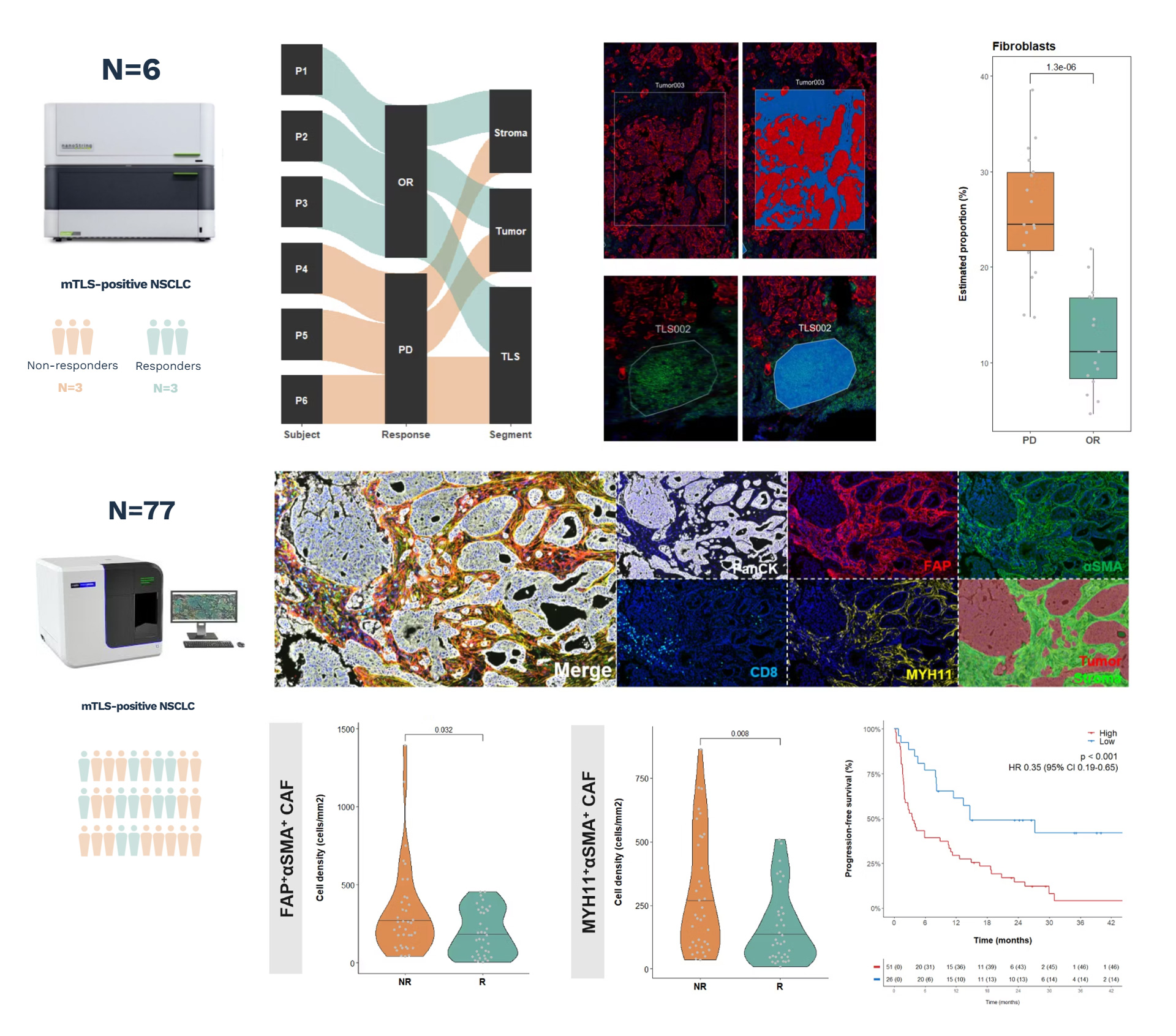
We employed this strategy in a 2025 Cell Reports Medicine paper: GeoMx profiling of 6 extreme cases (responders vs. non-responders) identified determinants of resistance to immunotherapy. The resulting hypotheses were then validated across 77 cases with a fast, cost-efficient mIF panel.

The question: Why do some NSCLC patients fail to respond to anti-PD-1/PD-L1 immunotherapy despite mature tumor lymphoid structures (mTLS) — a typically favorable phenotype?

Spatial transcriptomics (GeoMx): Among NSCLC patients with mTLS, non-responders show enrichment of fibroblasts in the stromal compartment.

Digital pathology validation: Non-responders show higher stromal density of FAP⁺αSMA⁺ and MYH11⁺αSMA⁺ CAFs, and the presence of these CAF subsets correlates with poor outcome.

oncology Target-identification strategy spatial transcriptomics

Sample multiplexing to reduce costs & lead times

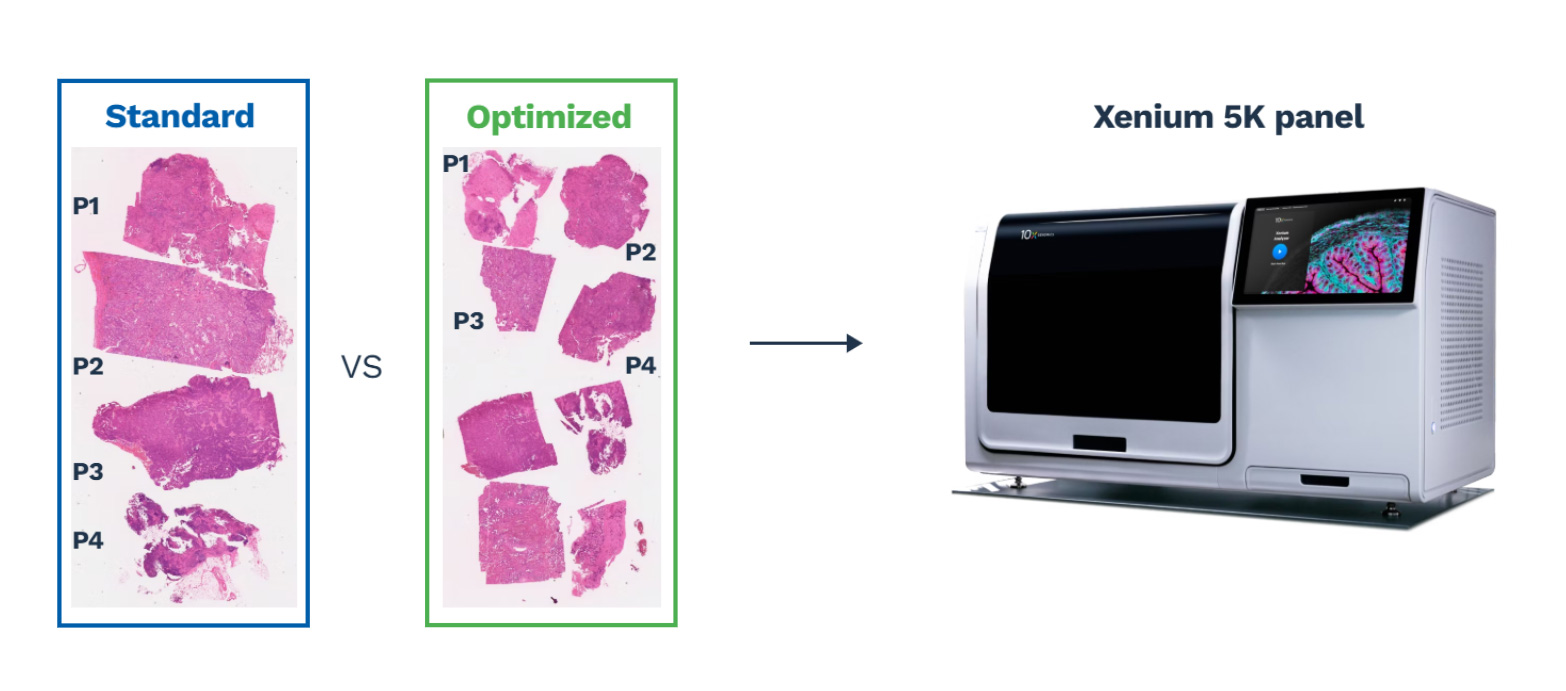
In partnership with AI company Bioptimus, we doubled the number of FFPE samples per Xenium slide and ran a rigorous head-to-head against the standard format.

The question: Can we cut the turnaround time and cost of Xenium studies without compromising data quality?

Results: Across QC metrics, cell-type proportions, and gene expression profiles, the data held up — sample-to-sample correlations between formats reached near-perfect agreement.

Take-home: Faster, more cost-effective spatial transcriptomic campaigns — built to accommodate large cohorts on Xenium.

oncology target identification single cell spatial transcriptomics CRO

Data integration for deeper spatial biology

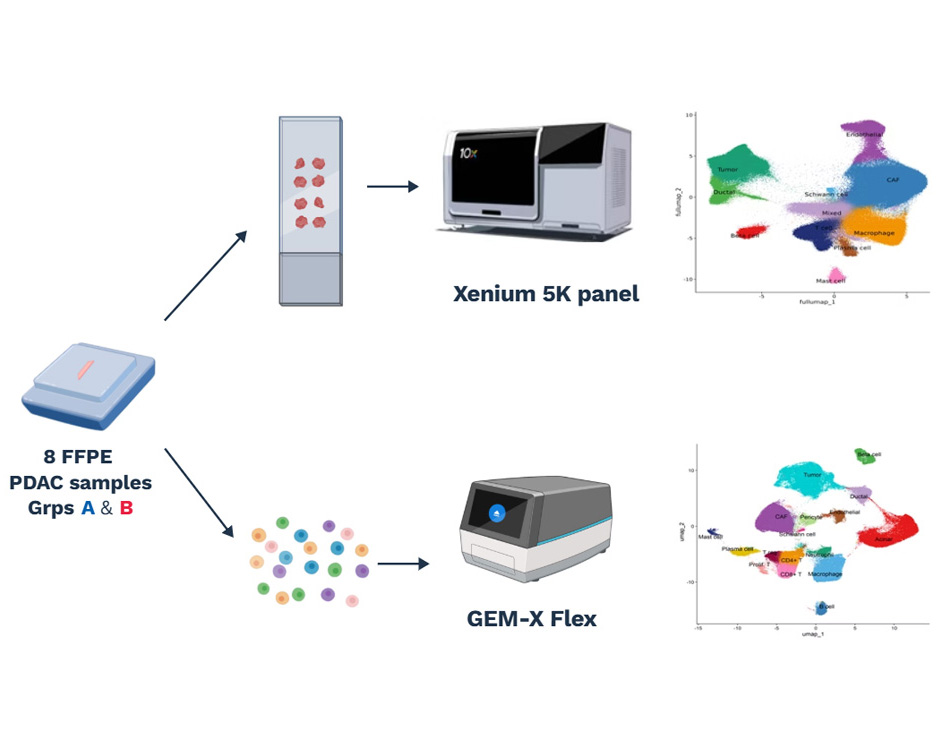
On a cohort of FFPE PDAC samples, we tested whether matched scRNA-seq data could unlock biology hidden from the Xenium 5K panel.

The question: By integrating scRNA-seq with Xenium, can we improve cluster annotation and resolve cell populations that are partially merged in standard Xenium analysis?

The results: Using the matched scRNA-seq dataset as a reference, we inferred richer transcriptomic information onto Xenium spatial coordinates — enabling deeper biological characterization while still resolving key spatial questions: cell localization, neighborhood organization, and tumor microenvironment architecture.

Take-home: Pairing scRNA-seq with Xenium is a strong asset for deep spatial biology — combining transcriptomic depth, improved cell annotation, and spatially resolved interpretation.

Xenium beyond 5K integration scRNAseq

Data science workflows to deliver actionable datasets faster

Through internal R&D, our data science team has built workflows to process and analyze high-dimensional datasets efficiently.

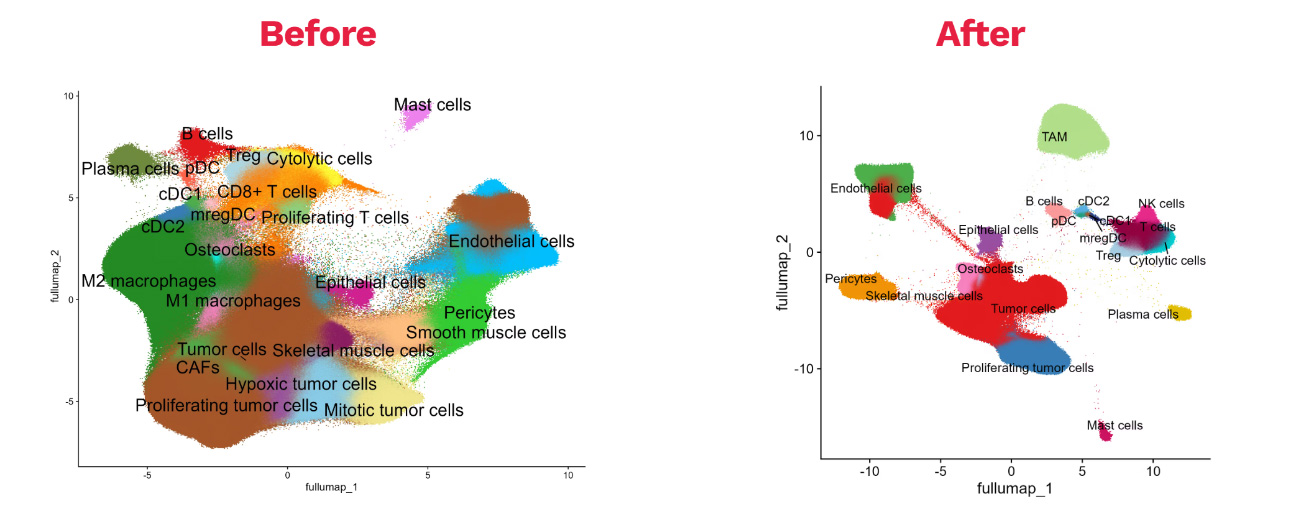
Validated processing pipelines: fast remapping, cleaning, and annotation of transcriptomic datasets (example, right).

Target prioritization: ranking strategies that account for your intended modality.

Custom analysis for decision-making: spatial analysis, differential gene expression, gene signature and pathway analysis, and in-depth statistics integrating clinical metadata.

oncology target identification prioritization single cell spatial transcriptomic analysis
The Explicyte team at their Bordeaux laboratory

Paul Marteau, PharmD (study director), Imane Nafia, PhD (CSO), Loïc Cerf, MSc (COO), Alban Bessede, PhD (founder, CEO), Jean-Philippe Guégan, PhD (CTO)

contact our team

Discuss your target identification project and request a quote

Whether you start from FFPE blocks, a specific indication, or an existing shortlist of candidate targets, we can help design the right transcriptomic strategy and define the next validation steps.

Answers about precision oncology discovery services

Frequently asked questions

What makes Explicyte different for FFPE-based target identification?

Explicyte is 10x Genomics Certified across Xenium, Visium HD, and Chromium X — and equipped to run GeoMx and bulk transcriptomic approaches as well. This breadth lets us recommend the platform that fits the question, not the platform we have to push. Our in-house data science team applies the same prioritization framework across platforms, so projects deliver ranked target candidates with a defensible evidence trail. Reflected in publications including Cell Reports Medicine, Annals of Oncology, and JITC.

FFPE transcriptomics-based target identification uses gene expression data from archival tumor tissues to discover, nominate, and prioritize therapeutic targets and biomarkers for downstream validation. It helps translate human tumor biology into ranked candidate targets supported by molecular evidence.

Transcriptomics is a strong starting point when you want to explore human tumor biology in an unbiased or semi-targeted way, compare subtypes or clinical strata, or identify candidates before moving into tissue-level validation. It is particularly useful when the goal is nomination and prioritization rather than immediate confirmation of a preselected target.

The right platform depends on the balance you need between transcriptome breadth, spatial context, resolution, throughput, and budget. In practice, we recommend the technology based on the biological question and study design rather than the platform alone. Some projects require broad discovery across many samples, while others benefit more from spatially resolved analysis of tumor and microenvironment context.

Whole-transcriptome approaches are best for broad, unbiased discovery and biological exploration. Focused panels are more efficient for hypothesis-driven questions, faster iteration, and tighter budget control. The right choice depends on how exploratory the project needs to be and how much transcriptomic breadth is required to support target nomination.

Yes. Many projects benefit from combining broad discovery on one platform with spatial follow-up on another. For example, a cohort-scale transcriptomic screen can be used to nominate candidates, followed by spatial profiling to understand cell-type specificity, tissue architecture, or tumor microenvironment context before moving into validation.

A strong target typically combines several favorable signals rather than one metric alone. Depending on the project, we may prioritize candidates based on prevalence, specificity, biological relevance, association with clinical or pathological variables, druggability, and safety-related considerations. The weighting of these criteria is adapted to the indication and program objectives.

Not usually. Transcriptomics is highly valuable for discovery and prioritization, but full validation often requires orthogonal confirmation at the tissue or protein level. Once promising candidates are identified, the next step is often target expression profiling to assess prevalence, localization, heterogeneity, and normal tissue distribution.

Target expression profiling is the natural next step when you need to confirm whether nominated targets are truly expressed in the relevant cells and tissue compartments, and whether that expression pattern supports downstream development. It is especially important when prevalence, localization, heterogeneity, or normal tissue distribution will influence go or no-go decisions.

Explicyte Oncology CRO logo

Capabilities

Modalities